
Mechitcalc 1.1
Mechitcalc 1.1 is live. It’s a smaller release than 1.0, but it adds the flange calculation I kept getting asked about, a proper materials rework, the math written out on the page, and a free no-login flange calculator.
If you’re a piping or pressure-vessel engineer designing to ASME B31.3 or EN 13480, or you spec flanges to EN 1092-1, this is for you. You can try it at https://mechitcalc.com.
Compared with 1.0, the headline changes are a new flange table selector for EN 1092, an update to the materials system, unit flexibility, and the new documentation pages.
What’s new at a glance
- EN 1092-1 flange pressure rating — full process
- Young’s modulus E(T) from material data — external pressure page
- Free no-login flange calculator — free EN 1092-1
- Switchable units (MPa / bar, °C / °F)
- Full documentation pages — every module now has its own page writing out the process (full list below)
EN 1092-1 flange pressure rating
This is the biggest new piece (method page). A flange rating is not a formula, it is a table problem. EN 1092-1 publishes, for every PN class from PN 2.5 to PN 400, a dimensions table and two pressure-rating tables (one for non-austenitic, one for austenitic materials), each keyed by temperature and by the forging VR dimension. So “does this DN 100 PN 16 P245GH flange hold 16 bar at 350 °C?” is just a table lookup — you have to find the right row and the right temperature, then apply the rules for that flange type.
The program loads the full EN 1092-1 table set (dimensions + non-austenitic ratings + austenitic ratings, per PN) into the database and reads it directly. For a given DN, material, PN and a set of flange types (01, 05, 11, 12, 13, 21, 32+02, 34+04, 35+02, 36+02, 37+02) it checks each type and reports the governing maximum allowable pressure (MAWP) and the utilisation.
Here’s what it checks, type by type:
- Standardisation limits — each flange type only exists up to a certain DN for a given PN (and PN 160–400 excludes DN 20/DN 32). A type that is not permitted for that DN is marked “X” and excluded.
- Austenitic-only types — types 35/37 are only valid for austenitic materials.
- VR forging dimension — from the type-specific dimension the code computes the nominal VR forging size as
VR = max_dimension / 0.8, because at most 80 % of the forging can be machined away. - Rating-row selection — for austenitic materials the top row of the table is used; for non-austenitic the smallest VR band whose upper limit
VR_tois at or above the computed VR. - MAWP at design temperature — the selected row gives a temperature → PS (bar) curve; the design pressure is linearly interpolated between the two bracketing temperature points (the RT column covers −10…50 °C and is taken as 50 °C).
- Wall-thickness / corrosion check — for the types that carry a minimum thickness (11/21/34, 01, 35/36/37) the required thickness is derived from the table dimension minus the included material (1 mm for non-austenitic, 0 for austenitic) plus your corrosion allowance
c_A, and the given wall must be ≥ that.
The governing result is the lowest MAWP across all allowed types:
MAWP   = min( MAWP over all evaluated flange types )
util   = P_design / MAWP  × 100 %
pass   = P_design ≤ MAWP  AND  no type rejected
Young’s modulus from material data
A 1.0 roadmap item was “Young’s modulus lookup for external pressure from material info.” That’s done now. The EN 13480-3 external pressure (buckling) calculation is stiffness-driven — the critical collapse pressure scales with E. In 1.0 you typed E in by hand. Now it comes from the material.
For EN materials, E(T) is taken from EN 13480-2 Table G31 as a quadratic in temperature, E = c0 + c1·T + c2·T², with coefficients grouped by steel type (group 1/4/5.x for carbon & low-alloy, 5.3/5.4/6/7 for austenitic, 8.x provisional). The material’s W-number (DIN number, e.g. 1.4301 → group 5.3) selects the row. For ASME materials, where there is no W-number, the group is inferred from the P-Number (P-No. 8 → austenitic, etc.), which is the same cross-code inference the material system already used for the design stress.
P_m = E · e_a · ε / R_m (EN 13480-3 elastic critical pressure)
If a material can’t be resolved to a group, the calculation fails per pipe with a clear note instead of silently defaulting to 200 000 MPa. You can always override E directly if you have a better value.
Free calculators
1.1 adds a no-login version of the EN 1092-1 flange rating so you can try the tool without an account:
- Free EN 1092-1 flange rating — https://mechitcalc.com/free/en1092flange — a single pressure/temperature case, no saving or report export.
It uses the same calculation engine as the full calculator, through a public endpoint, just with one case and no save or report. The idea is that you can size a flange in two minutes and see the report-style output before you sign up.
The full process of each module written out
In 1.0 the formulas were only visible in the result table’s formula viewer. In 1.1 I added a set of content pages (served at /page/<slug>) that write out each calculation and show its equations, rendered with KaTeX. Every module now has its own page — the 14 new pages, all linked from their calculators:
European (EN)
- EN 13480 / EN 13445 straight pipe wall thickness
- EN 13480 pipe bend wall thickness
- EN 13480 / EN 13445 external pressure
- EN 13480 / EN 13445 branch connection reinforcement
- EN 10253 welding tee reinforcement
- EN 13480 dished (elliptical) head thickness
- EN 1092-1 flange pressure rating
American (ASME B31.3)
- ASME B31.3 straight pipe wall thickness
- ASME B31.3 pipe bend wall thickness
- ASME B31.3 external pressure
- ASME B31.3 branch connection reinforcement
Reference pages
- Design stress (σ_d) per code — every code’s σ_d formula and safety factors side by side
- Hydrostatic test pressure
- Pipe wall-thickness tolerances
Each calculator links to its page, and there’s a DesignStressLink button on every page that jumps to the design-stress reference. I also upgraded the per-result FormulaViewer so you can pick a specific case and a specific pipe, then step through the calculation with each formula rendered. On the back end, the verbose steps now cite the exact code formula (e.g. “EN 13480-3 formula 6.1-1”) instead of a generic “using the EN formula”, so the report shows which equation it actually used.
Front-end: SSR, SEO, and units
The front end (Svelte 5 / SvelteKit) got a rework for the web:
- Switchable units. A settings modal lets you choose how pressure and temperature are displayed — MPa or bar, and °C or °F. The important part is that values are stored and calculated in base units (MPa, °C) and only converted at the display boundary, so toggling units can never change a result. Your choice is saved locally.
- Flange selection wizard. The EN 1092-1 input is a guided selector: pick material (grouped non-austenitic/austenitic), PN, flange types, then a DN range, and it builds the calculation set with auto-suggested wall thicknesses per DN — the tedious part of flange input is gone.
- Quality fixes. The result table no longer double-formats the utilisation (the “62.5 %%” bug), dark-mode markdown styling is complete, and the material search handles empty queries correctly.
Report improvements
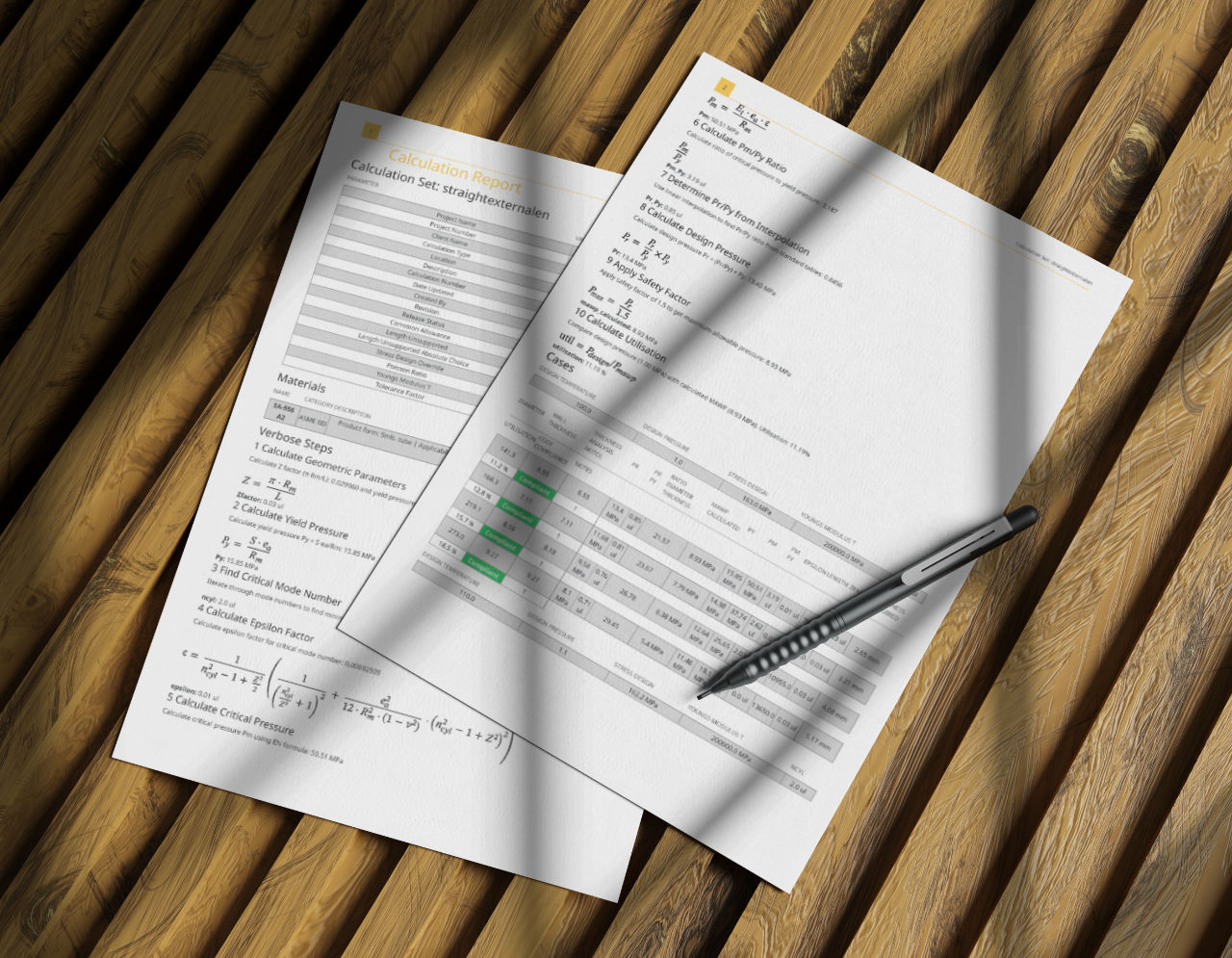
The PDF report got a few fixes:
- No more split tables. Tables now keep to a single page (
break-inside: avoid), so a 200-row result table never gets torn across a page break mid-row. - Calculation type in the header. Each calculation set is titled with its type and starts on a new page with the type carried in the running header.
- Specific formula citations. The verbose section shows the exact code formula per step (see above).
Where this leaves the roadmap
With flanges in, what’s next:
- DNV / ship-class minimum wall-thickness checks as first-class calculations (the design-stress side is already there).
- EN13480/B31.3 set-in branches (set-on is done; set-in is the remaining geometry).
- More B16.5 flange families
- A fuller ASME P-Number → E(T) mapping (the 21/22/31 families have no Table G31 row yet).
- A compliance module that stacks design codes together with classes or laws. For example B31.3 + PED or EN13480 + DNV-RU gas fuelled ships.
Give it a spin at https://mechitcalc.com — the free flange calculator is the fastest way to see the new feature.