
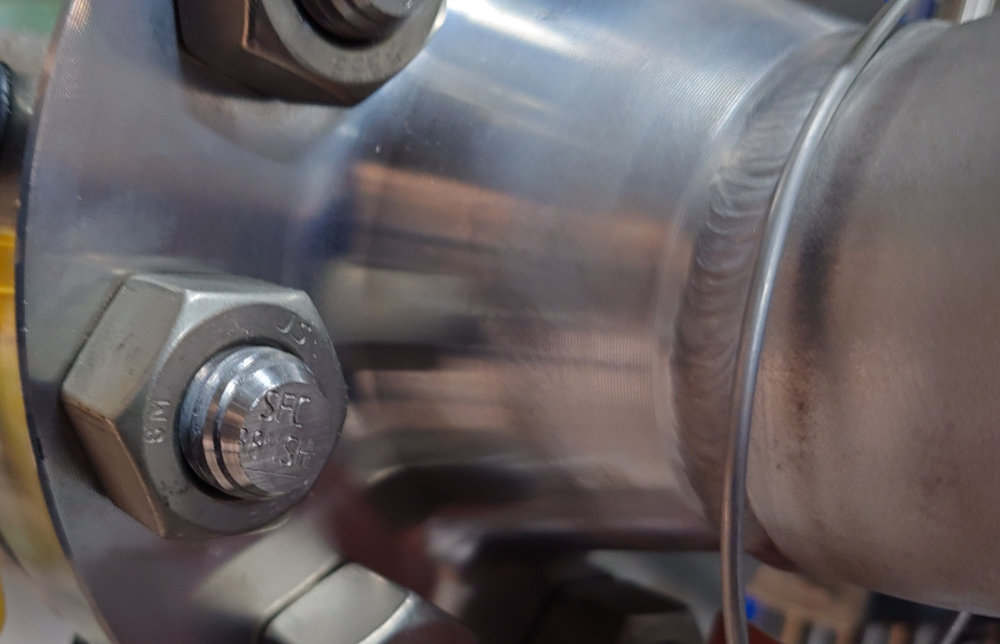
Elevated Temperature Stainless Steel Bolting to EN 13480 and EN 13445
The problem comes up when you have somewhat higher-pressure stainless steel connections designed according to EN 13480 or EN 13445.
Stainless steel bolting has a somewhat confusing material designation when it comes to pressure equipment according to the PED. Normally, you would look at EN 10269 for the bolting material. But EN 10269 does not give you elevated-temperature data for every condition you might want to use.
Let’s take a common example: A4-70 stainless steel bolting.
The problem with A4-70
If you look at A4-70, you end up at 1.4404 as the material in EN 10269, which is fine as far as the base material goes.
Let’s say we have an installation temperature of 20 °C and a design temperature of 100 °C. This is actually a very common situation for equipment that normally runs at around 70 °C.
The problem is that the material condition makes a big difference.
For 1.4404 in the +AT condition, the minimum yield strength is around 200 MPa. In the C700 condition it is around 350 MPa.
An A4-70 bolt is very common when used in this type of application, so it is tempting to just use the room-temperature properties of the material.
But this is where things get difficult.
For austenitic stainless steels, you cannot simply use the room-temperature values when the design temperature increases above 20 °C. This is different from ferritic and martensitic steels. EN 13480-3 has specific rules for this.
So technically, as soon as the design temperature goes above 20 °C, you need to look at the temperature-dependent properties of the bolting.
And the values for the +AT condition are quite low.
For example:
- At 50 °C: approximately 187 MPa yield strength
- At 100 °C: approximately 165 MPa yield strength
What about ASME bolting?
This becomes even more interesting when comparing this to the stainless steel bolting commonly used with ASME pressure equipment.
Take ASTM A193 B8M, for example.
B8M has Class 1 and Class 2, which are somewhat comparable to the different strength levels we see with stainless fasteners.
For Class 1, the minimum yield strength is around 205 MPa.
At elevated temperatures, this becomes approximately:
| Temperature | Minimum yield strength |
|---|---|
| Room temperature | 205 MPa |
| 50 °C | 201 MPa |
| 100 °C | 176 MPa |
Class 2 is stronger, although the required strength depends on the bolt diameter.
For example, for diameters between 30 and 36 mm, the minimum yield strength is around 345 MPa. At elevated temperature this is approximately:
| Temperature | Minimum yield strength |
|---|---|
| Room temperature | 345 MPa |
| 50 °C | 340 MPa |
| 100 °C | 233 MPa |
And for smaller diameters the material can be significantly stronger. Below around 20 mm, the minimum yield strength can be as high as 655 MPa.
So there is quite a difference between the available ASME bolting grades and the values you can end up with when using the EN 10269 data for a standard A4-70 bolt.
So what can we do?
This is where ISO 3506 becomes interesting.
For materials such as A4-70, ISO 3506-1 is specifically mentioned as a standard for these fasteners.
Technically, EN 10269 doesn’t actually use the A4 designation itself. It gives you the material designation and material number. ISO 3506, on the other hand, explicitly deals with the familiar A2, A4, etc. designations and references the relevant material standards.
I’m not 100% sure about the exact ordering and availability of these materials in the market, so this is something that should be checked with the fastener supplier.
But if you specify the fastener according to ISO 3506 as A4-70, you are specifying a fastener according to that standard, rather than simply specifying a generic 1.4404 bolt.
This is also relevant because ISO 3506 is referenced in EN 13445.
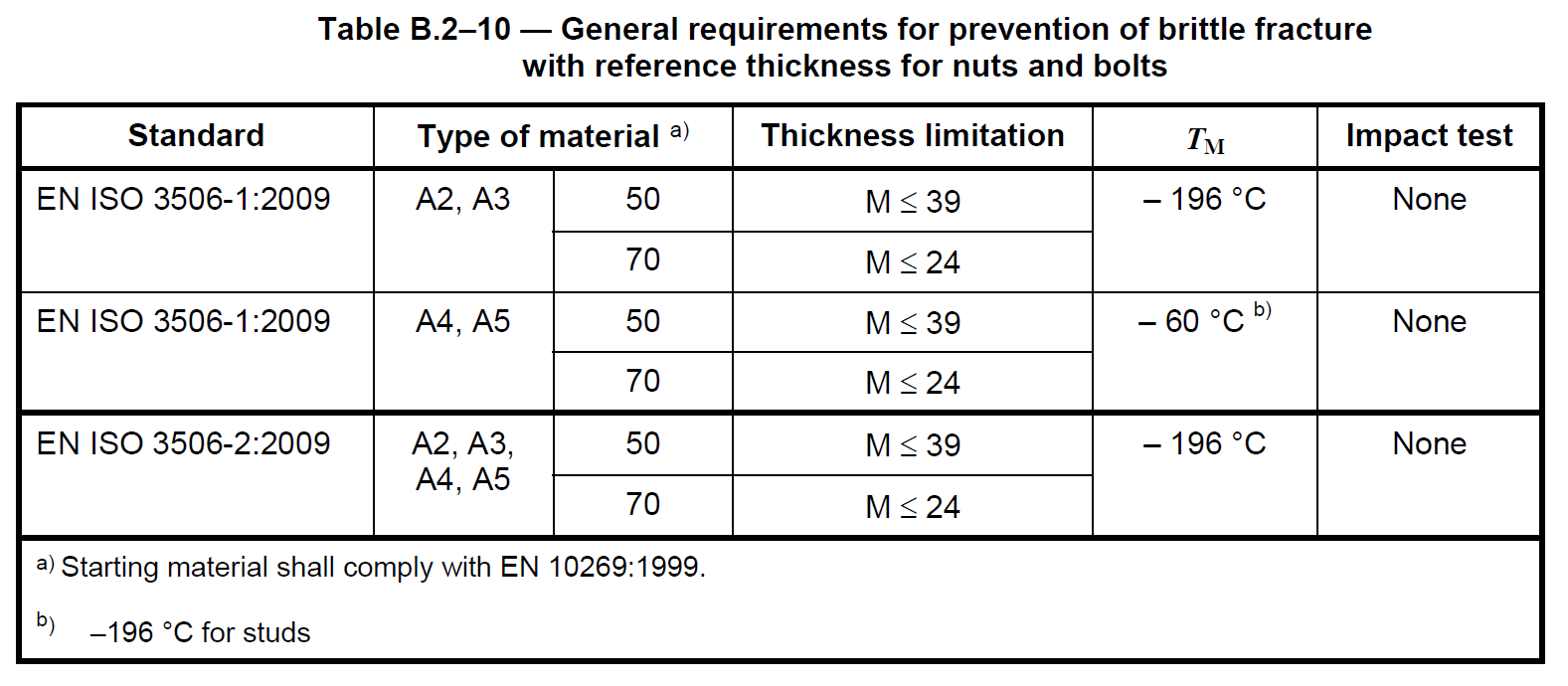
EN 13445 contains data for these fasteners using the ISO 3506 designations, such as A4-70, together with the relevant testing requirements.
The problem is that ISO 3506 itself doesn’t give you the same type of detailed elevated-temperature material data that you might normally want for a pressure equipment calculation.
However, it does provide guidance for elevated temperatures.
Elevated temperature reduction factors
ISO 3506 gives reduction factors for the mechanical properties at elevated temperature.
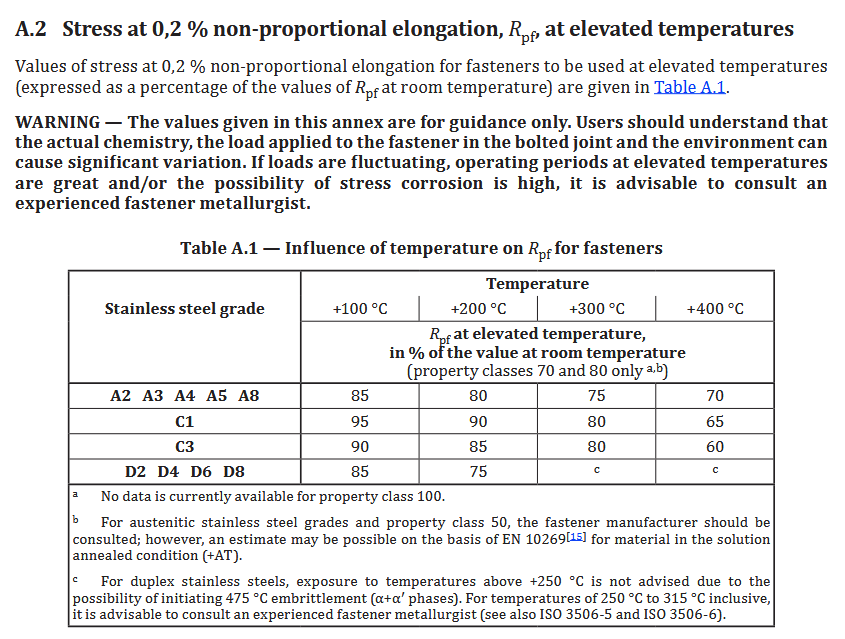
There is an important disclaimer with these values:
Values given in this annex are for guidance only.
The standard points out that the actual chemistry, the load applied to the fastener in the bolted joint and the environment can cause significant variations.
It also recommends consulting an experienced fastener metallurgist when, for example:
- loads are fluctuating;
- operating periods at elevated temperatures are long; or
- the possibility of stress corrosion is high.
For property classes 70 and 80, the table gives the following factors for A2, A3, A4, A5 and A8:
| Temperature | Reduction factor |
|---|---|
| +100 °C | 85% |
| +200 °C | 80% |
| +300 °C | 75% |
| +400 °C | 70% |
So one possible approach is to take the room-temperature values from EN 10269 and apply these reduction factors.
For example, if we have an A4-70 fastener and want to evaluate it at 100 °C, we could take the applicable room-temperature property and multiply it by 0.85.
This gives us a much more reasonable value than simply using the very low +AT values from EN 10269.
For applications close to room temperature, such as the 50–70 °C range that I commonly come across, this seems like a reasonable approach to investigate.
Stress corrosion
There is another reason why this should not simply be treated as a mechanical-property calculation.
Stainless steel bolting can be susceptible to stress corrosion depending on the environment and the actual conditions of the joint.
This is specifically why ISO 3506 includes the warning about the environment, fluctuating loads and long periods at elevated temperature.
For a relatively low-temperature application, this might not be a major concern. But if the temperature starts increasing, or if the environment is aggressive, you cannot simply take the reduction factor from the table and consider the calculation finished.
Conclusion
This is one of those cases where the material designation looks straightforward until you actually try to perform the pressure equipment calculation.
A4-70 is extremely common bolting, but when you use EN 13480 or EN 13445 and the design temperature is above room temperature, the available material data can suddenly become quite restrictive.
At 100 °C, using the EN 10269 +AT values can give you a yield strength of only around 165 MPa. Once the applicable design factors are applied, this can result in a very low allowable stress for the bolt.
That can make an otherwise completely normal bolted connection surprisingly difficult to verify.
ISO 3506 gives another route because it explicitly defines the A4-70 fastener designation and provides guidance for reducing the room-temperature properties at elevated temperatures.
For applications around 50–70 °C, this may provide a much more realistic basis for the calculation, but the limitations of the ISO 3506 elevated-temperature factors need to be kept in mind.
And, as always with bolting, the material strength is only part of the story. The actual joint, loading, temperature exposure and environment all matter.
Sources
- EN 13445
- EN 13480
- EN 10269
- ISO 3506-1